
Written by the clinical team at Integrative Psychiatry and Wellness (IPW Health).
Published September 16, 2026.
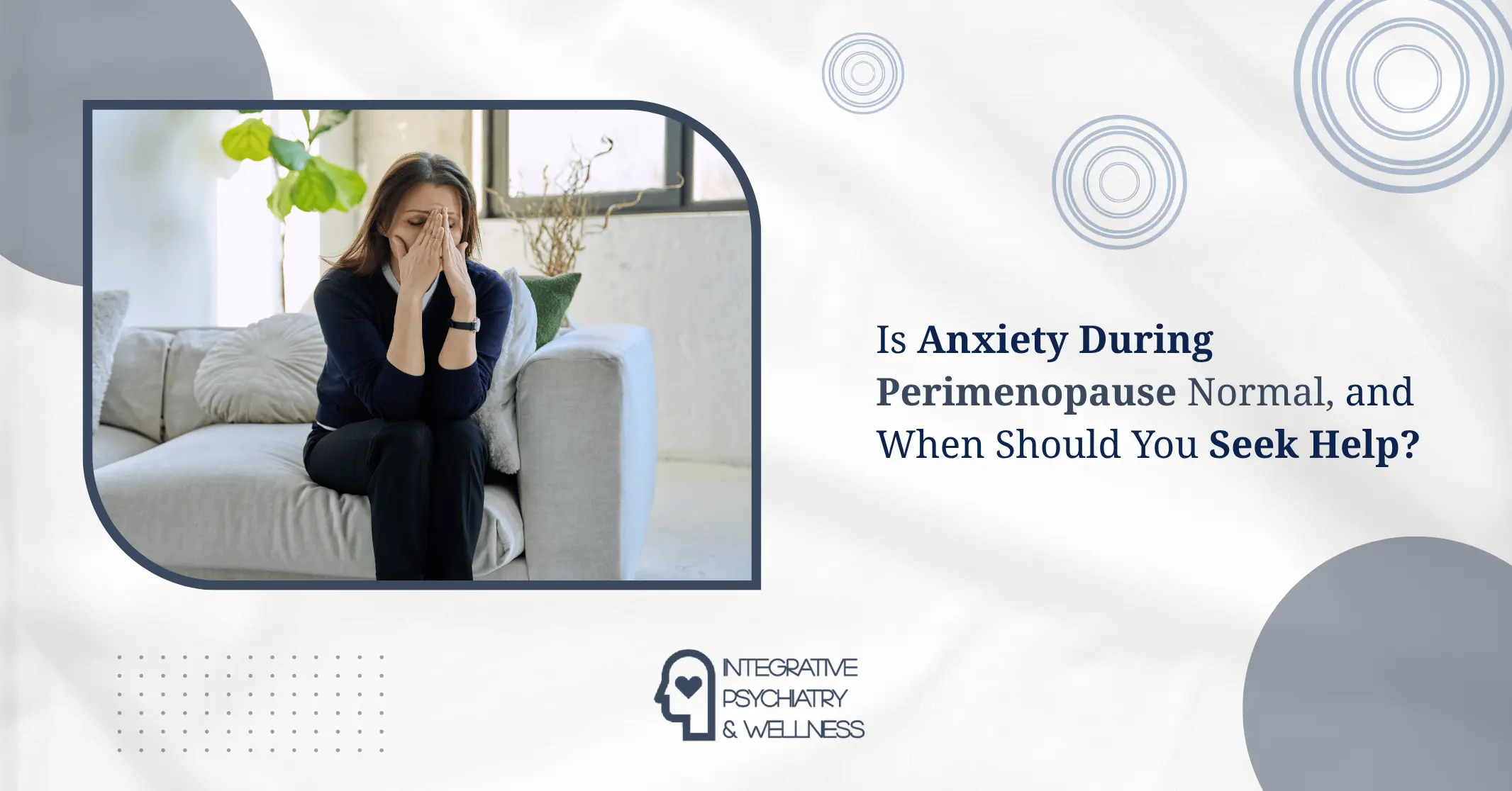
You have never been an anxious person. Now you wake at four in the morning with your heart going, or you notice you are bracing for something all day without being able to name it, or a work email produces a reaction out of all proportion to the email.
And the thing you keep circling back to is that nothing in your life has changed enough to explain it.
If you are somewhere in your forties, this is worth taking seriously in both directions. Anxiety genuinely does rise during the menopause transition — you are not imagining a pattern. But “it’s hormones” is also a common reason a treatable medical condition goes unfound in women this age. Both things are true.
What perimenopause actually is
Perimenopause is the transition leading to menopause — the point at which menstrual periods have stopped for twelve consecutive months.
It typically begins in the forties, sometimes in the late thirties, and lasts several years; the range is wide and individual.
The defining feature is not a smooth decline. Estrogen in particular fluctuates erratically — sometimes higher than in your twenties, sometimes very low, often within the same month. That instability distinguishes perimenopause from the relative steadiness of post-menopause, and is probably relevant to why symptoms cluster here rather than after periods stop.
Does anxiety really increase? Yes
Research consistently finds that anxiety symptoms, irritability and depressive symptoms are more common during the menopause transition than before it. The transition is a recognized window of elevated risk — not just for anxiety, but for depressive episodes.
Prior history is the strongest predictor. If you have had depression before — including postpartum depression — or significant premenstrual mood symptoms, your risk of an episode during this transition is meaningfully higher. That is a reason to be watchful rather than dismissive.
New onset also happens. People with no psychiatric history develop first episodes of depression or significant anxiety during this window. Never having had it before is not evidence that this isn’t it.
What the hormone connection actually is — and isn’t
The more honest version: estrogen receptors are widely distributed through brain regions involved in mood and stress response, and estrogen interacts with serotonergic and noradrenergic signalling. One leading hypothesis is that it is variability in estrogen — the size and speed of the swings — rather than low estrogen itself that matters for mood.
The crucial practical consequence: hormone levels do not predict who develops symptoms, and a hormone panel will not tell you whether your anxiety is “hormonal.” Two people with near-identical hormonal profiles can have entirely different mood experiences. This is why clinicians generally do not diagnose perimenopausal mood symptoms from bloodwork.
What else produces exactly these symptoms
Racing heart, sweating, tremor, poor sleep, irritability, fatigue and difficulty concentrating are the symptoms of perimenopausal anxiety. They are also the symptoms of several other conditions that become more common in the same decade.
Thyroid disease. Hyperthyroidism produces anxiety, palpitations, heat intolerance, sweating, tremor and insomnia; hypothyroidism produces fatigue, low mood and cognitive slowing. Thyroid disease is considerably more common in women and its incidence rises with age. It is testable and treatable, and this overlap is the main reason thyroid function should be checked before new anxiety is put down to perimenopause.
Anemia. Fatigue, palpitations, breathlessness and poor concentration. Heavy or irregular bleeding is itself common in perimenopause, which makes this more, not less, likely.
Cardiac arrhythmia. Palpitations that come out of nowhere deserve a cardiac explanation ruled out rather than assumed away. New palpitations with chest pain, breathlessness or fainting need urgent assessment, not a psychiatric appointment.
Vasomotor symptoms mistaken for panic. A hot flash — sudden heat, flushing, sweating, then a chill, with a pounding heart — is genuinely hard to distinguish from a panic attack in the moment, and the two can trigger each other. The useful question is what came first: the heat surge, or the fear.
Sleep disruption. Night sweats and insomnia fragment sleep, and poor sleep produces daytime anxiety, irritability and poor concentration on its own. Sometimes the anxiety is downstream of the sleep, and treating the sleep is the more effective intervention. (read more on sleep and hormonal shifts)
Other contributors worth naming: alcohol, caffeine, stimulant medications, thyroid or steroid medication, and the life circumstances that cluster in this decade.
IPW Health orders and interprets laboratory work directly, so this part of the workup happens within the practice. Where the picture points to a cardiac cause, a gynecological cause or a medication question outside psychiatric care, we co-manage with your OB-GYN or primary care clinician.
How to tell ordinary transition symptoms from something that needs treatment
There is no threshold on a lab result. The distinction is about persistence, pervasiveness and cost.
Consistent with the transition: anxiety that comes and goes, that tracks with bad nights or symptomatic days, that you can still talk yourself down from, that does not stop you doing things, and that leaves you recognizably yourself in between.
Suggests an anxiety disorder or a depressive episode: worry present most days for weeks and difficult to control; anxiety no longer attached to anything in particular; avoiding things you used to do; a persistent drop in interest or enjoyment; hopelessness or self-criticism that feels like a factual assessment rather than a mood; concentration problems affecting work; panic attacks, especially unprompted ones; or a level of distress you are organizing your life around.
The practical question a clinician will ask is: what has this stopped you doing? Symptoms you work around differ from symptoms that have taken things from you.
Seek help promptly — not eventually — if there is hopelessness, if you are withdrawing from people, if you have a prior history of depression and recognize the shape of it returning, or if there are thoughts of not wanting to be alive.
What treatment involves
Psychotherapy. Cognitive behavioral therapy has the strongest evidence base for anxiety disorders and depression, and it works for menopause-related anxiety as it does elsewhere. It is delivered in house by our therapy team.
Psychiatric medication. At the level of class and purpose only: antidepressant medications — principally the serotonergic and serotonin–noradrenergic classes — are the usual pharmacological treatments for anxiety disorders and depressive episodes, including in this age group. Certain agents in these classes also have an established role in reducing vasomotor symptoms, which is sometimes relevant when both problems are present. Whether medication is appropriate at all, and which one, are clinical decisions that depend on your history. This article is not a recommendation to start or stop anything.
Hormone therapy. This deserves a careful paragraph rather than a slogan.
Hormone therapy is an established and effective treatment for vasomotor symptoms, and for many people it is a reasonable option. It carries genuine risk–benefit considerations that vary substantially with your age, how long since your final period, your personal and family history — particularly of breast cancer, clotting disorders and cardiovascular disease — and the formulation used. Those considerations have been revised repeatedly as the evidence has been re-analysed, in both directions.
What the evidence supports less well is hormone therapy as a treatment for anxiety or depression specifically. Some findings suggest a mood benefit for some people during the perimenopausal window, but it is not an established treatment for an anxiety disorder or a depressive episode and should not be presented as one. Where it helps mood, part of that may be through improving sleep and vasomotor symptoms.
This is a decision for the clinician who knows your history and manages your menopause care — usually your OB-GYN or primary care clinician, with our input on the psychiatric side. We are not recommending it here, and we are not telling you to avoid it. It is a real option that belongs in a real conversation.
What to do next
Bring to an appointment: when the symptoms started, what they stop you doing, your sleep, your cycle pattern, your alcohol and caffeine intake, any prior episodes of depression or anxiety including postpartum, your family history, and anything you take — prescribed or not.
Expect an evaluation that considers the medical possibilities above as well as the psychiatric ones. Attributing it to hormones should be a conclusion, not a starting assumption.
IPW Health provides psychiatric evaluation and medication management by telehealth in California, Oregon, Washington and Colorado, and in person in Mission Viejo, California. We order and interpret laboratory work directly, our therapy team delivers cognitive behavioral therapy in house, and we co-manage with your OB-GYN or primary care clinician where menopause care or a medical cause is the appropriate route.
This article is general education, not medical advice, and reading it does not create a patient–provider relationship. Treatment decisions depend on your history and should be made with a clinician who knows it.
If you are in crisis or having thoughts of harming yourself, call or text 988 to reach the Suicide and Crisis Lifeline, available 24 hours a day in the United States. If you are in immediate danger, call 911.
Sources
- American College of Obstetricians and Gynecologists (ACOG). Clinical guidance on the menopausal transition, vasomotor symptoms and hormone therapy.
- The Menopause Society. Position statements on hormone therapy and on depression and mood in the menopause transition.
- National Institute of Mental Health (NIMH). Anxiety Disorders; Depression; women’s mental health materials.
- American Psychiatric Association. Diagnostic and Statistical Manual of Mental Disorders, Fifth Edition, Text Revision (DSM-5-TR).
- National Institute of Diabetes and Digestive and Kidney Diseases (NIDDK) / American Thyroid Association. Patient guidance on hyperthyroidism and hypothyroidism.
- National Institute on Aging (NIA). What Is Menopause?
- U.S. Food and Drug Administration. Approved labeling for menopausal hormone therapy products.