
Medically reviewed by Shahrzad Shadmani, PMHNP-BC, FNP-C, founder of Integrative Psychiatry and Wellness (IPW Health).
Published September 16, 2026.
Anxiety that persists stops being a mood and starts being a constraint. It shapes which emails you open, which calls you take, how long you lie awake, and how much of your attention is left for anything else. People look hard for something that will make it stop.
Adderall comes up in that search often — usually because someone has watched a friend or colleague become visibly calmer and more organised on it, and concluded that it must settle the nervous system.
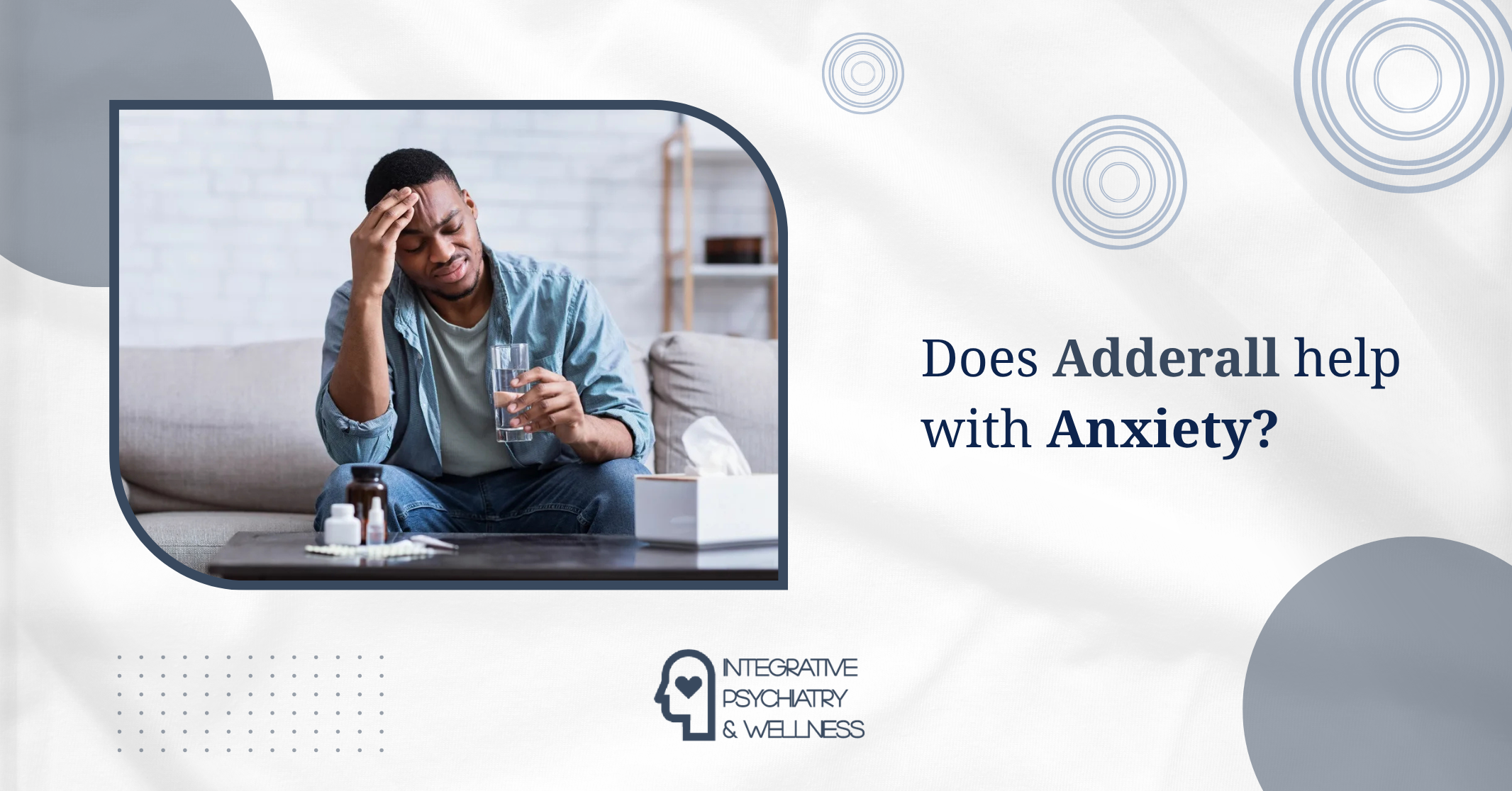
The short answer is no. Adderall is not indicated for anxiety, and for some people it makes anxiety worse. The longer answer is more useful, because the reason people ask this question often points at something real and treatable.
What Adderall is actually used for
Adderall is a central nervous system stimulant. According to FDA-approved labeling, it is indicated for attention-deficit/hyperactivity disorder and for narcolepsy. Anxiety is not among its indications.
The label describes its effect in ADHD in terms of improved attention and reduced impulsiveness and hyperactivity, and states that medication is intended to be part of a broader treatment plan rather than the whole of it.
That distinction is the heart of this question. Stimulants act on attention regulation, impulse control and alertness. They are not designed to reduce fear, worry or panic, and they do not target the mechanisms that anxiety disorders involve.
Anxiety disorders are a separate category of condition. As the National Institute of Mental Health describes them, anxiety disorders involve worry and fear that go beyond ordinary situational nervousness — symptoms that persist, that often intensify over time if untreated, and that interfere with work, school and relationships.
Why people think a stimulant might help
The confusion is reasonable, because ADHD and anxiety look similar from the outside and often feel similar from the inside. Both can produce:
- A mind that will not stop moving
- Difficulty starting or finishing tasks
- A constant sense of being behind and overwhelmed
- Restlessness
- Disrupted sleep
When someone with ADHD starts appropriate treatment and their days stop collapsing, they usually feel calmer. That is a real change — but it comes from the ADHD being treated, not from the anxiety being treated directly.
The inverse also happens. Someone with an anxiety disorder and no ADHD may take a stimulant expecting the same result and find themselves more wound up, not less.
This is exactly why a proper evaluation matters. A person may have anxiety alone, ADHD alone, or both — and the three call for different treatment. It is also why a stimulant should never be guessed at or borrowed.
Adderall is a controlled substance
This part is usually left out, and it should not be.
Adderall is a Schedule II controlled substance under the federal Controlled Substances Act, the same category the DEA uses for medications with accepted medical use and a high potential for misuse and dependence.
In practice that means three things. Taking a stimulant prescribed for someone else is not a low-stakes shortcut — it is use without a diagnosis, without a cardiovascular history review, and without monitoring. Sharing or selling a prescribed stimulant is a felony, regardless of intent. And stimulants carry genuine risks of misuse and dependence that are managed through prescribing and follow-up, which is precisely what is absent when the medication does not come from a clinician who knows you.
If you have been taking someone else’s stimulant to manage what feels like anxiety, that is worth telling a clinician plainly. It is clinical information, not a confession.
Why Adderall can make anxiety worse
Stimulants speed up physiological arousal. FDA labeling for amphetamine products lists adverse effects that include increased heart rate and blood pressure, restlessness, irritability, insomnia and anxiety.
For someone already anxious, those effects can land directly on top of the symptom. The physical sensations of stimulant activation — a fast pulse, tension, jumpiness, difficulty settling — overlap closely with the physical sensations of anxiety itself, and the body does not reliably distinguish between them.
Sleep is the other route. Stimulants taken later in the day can interfere with sleep, and short or poor sleep reliably amplifies anxiety the following day. The effect compounds across a week.
If you have anxiety and a stimulant is being considered, say so before you start. It changes how the decision is made and how closely you are followed afterward.
When ADHD and anxiety occur together
ADHD and anxiety co-occur frequently in both children and adults, and this is where the simple answer stops being sufficient.
Overlapping symptoms make the picture genuinely difficult to read:
- Difficulty concentrating
- Restlessness
- Trouble relaxing
- Sleep problems
- Irritability
Here is the part the short answer misses. When someone has genuine ADHD and their anxiety is driven substantially by the consequences of untreated ADHD — missed deadlines, unopened mail, the daily anticipation of forgetting something important — treating the ADHD appropriately often reduces the anxiety. That is not the stimulant treating an anxiety disorder. It is the removal of a sustained source of anxiety.
So both statements are true at once. Stimulants are not a treatment for anxiety and can worsen it in some people. And for some people with ADHD, appropriate ADHD treatment improves anxiety symptoms considerably.
Which of those applies to you cannot be settled from a symptom list or an article. It requires an evaluation that looks at your history, what came first, what happens to your anxiety when demands change, and what else might be contributing.
Signs a stimulant may not be a good fit
If a prescribed stimulant is not working for you, it usually shows. Contact your prescriber if you notice:
- New or increased worry, agitation or panic
- Trouble falling or staying asleep
- A racing or pounding heartbeat
- Shakiness
- Irritability or anger that is out of character
- Loss of appetite or unintended weight loss
Do not stop a prescribed stimulant on your own. Talk to the clinician who prescribed it — this is an adjustable situation, and there are options.
What anxiety disorders are actually treated with
Anxiety disorders have well-established treatments. None of them is a stimulant.
Psychotherapy. Cognitive behavioral therapy has the strongest evidence base for anxiety disorders in adults, including exposure-based approaches for panic disorder and specific phobias. It teaches you to work with anxious thinking and to stop the avoidance that quietly maintains anxiety over time.
Medication. SSRIs and SNRIs are the medication classes most commonly used first for anxiety disorders, and benefit typically builds over weeks rather than immediately. Whether medication is appropriate, and which class, is a clinical decision — no dosing or specific agents are discussed here.
Benzodiazepines are sometimes prescribed for anxiety, and their role is limited. They work quickly but carry risks of tolerance, dependence and withdrawal with sustained use, and they are generally not a long-term answer for an anxiety disorder.
Daily foundations. Sleep, regular physical activity, limiting caffeine and other stimulants, and consistent social contact are not substitutes for treatment, but they measurably affect how much anxiety you carry.
The bottom line
Adderall treats ADHD and narcolepsy. It does not treat anxiety, and in some people it increases it.
If anxiety is what you are dealing with, there are treatments built for it. If ADHD is also in the picture, treating it properly may well improve the anxiety — but that determination comes from an evaluation, not from trying a medication and seeing what happens.
Ready for an evaluation that looks at the whole picture?
IPW Health provides psychiatric evaluation and medication management by telehealth in California, Oregon, Washington and Colorado, and in person in Mission Viejo, California. We offer adult ADHD evaluation and treatment for anxiety disorders, including cognitive behavioral therapy through our therapy team, and we are able to prescribe both stimulant and non-stimulant ADHD medication by telehealth in all four states we serve where that is clinically appropriate.
If you are trying to work out whether you are dealing with anxiety, ADHD, or both, an evaluation is the right place to start. Call (949) 259-5123 to schedule.
FAQs
Can Adderall cause panic attacks?
It can contribute. Stimulants increase heart rate and physiological arousal, and those sensations closely resemble the physical symptoms of a panic attack. In people prone to panic, that can be enough to set one off. Tell your prescriber if it happens.
Can I take Adderall if I have anxiety?
Sometimes, with a diagnosis and monitoring. Some people with both ADHD and an anxiety disorder do well on stimulant treatment; others do not tolerate it and are better served by a non-stimulant option. That decision belongs to you and a clinician who knows your history — and it should never be made by taking a medication prescribed to someone else.
This article is general education, not medical advice, and reading it does not create a patient–provider relationship. Treatment decisions depend on your history and should be made with a clinician who knows it.
If you are in crisis or having thoughts of harming yourself, call or text 988 to reach the Suicide and Crisis Lifeline, available 24 hours a day in the United States. If you are in immediate danger, call 911.
Sources
- U.S. Food and Drug Administration. Approved labeling for amphetamine/dextroamphetamine (Adderall) — indications, warnings and adverse reactions.
- U.S. Drug Enforcement Administration. Controlled Substance Schedules (amphetamine, Schedule II).
- National Institute of Mental Health. Anxiety Disorders; Attention-Deficit/Hyperactivity Disorder.
- American Psychiatric Association. Diagnostic and Statistical Manual of Mental Disorders, Fifth Edition, Text Revision (DSM-5-TR).
- American Psychological Association. Clinical practice guidance on cognitive behavioral and exposure-based treatment for anxiety disorders.