

Medically reviewed by Shahrzad Shadmani, PMHNP-BC, FNP-C, founder of Integrative Psychiatry and Wellness (IPW Health).
Published September 16, 2026.
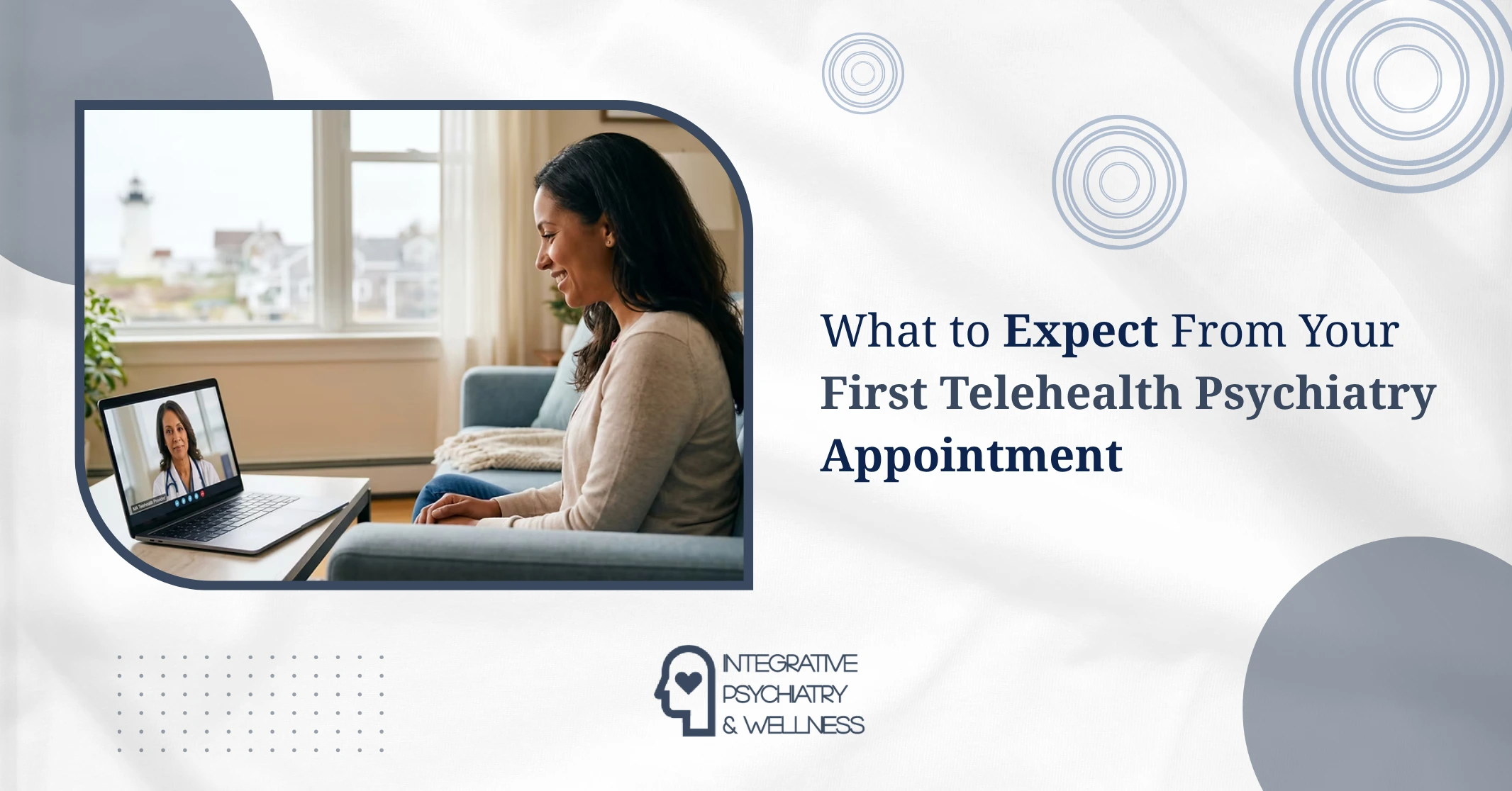
Booking a first psychiatric appointment takes something out of you, and doing it by video adds a layer of the unknown on top. Most people arrive at that first visit without a clear picture of what is about to happen — how long it will take, what they will be asked, and whether they will leave with anything useful.
Here is what the visit actually looks like, so you can walk into it knowing the shape of it.
Before the visit: what to have ready
You do not need to prepare a presentation. But a first evaluation covers a lot of ground in a limited window, and having a few things at hand means the time goes to the conversation instead of to looking things up.
A current medication list. Everything you take, psychiatric or not — name and how long you have been on it. Include over-the-counter medicines and supplements; some of them interact with psychiatric medications. If it is easier, photograph the bottles.
What you have tried before. Past psychiatric medications matter enormously, even ones that did not work. What helped, what did not, what caused side effects, and roughly when. An imperfect list is far better than none.
A short history. Any psychiatric diagnoses you have been given, hospitalisations, therapy you have had, and relevant medical conditions. Family history of mental illness is useful too, if you know it.
Your pharmacy. Name and cross streets, or the exact branch. If a prescription is sent that day, this is what prevents it going to the wrong location.
Two or three questions of your own. Write them down. It is remarkably easy to leave a first appointment having forgotten the thing you most wanted to ask.
The intake paperwork. Complete it before the visit rather than in the ten minutes before. Insurance verification is handled ahead of time as well.
Setting up: the practical side
Find a private space where you will not be overheard and will not be interrupted. A closed room is ideal; a parked car works; headphones help if the household is close by. Use your own device on a network you trust rather than public wi-fi. Test your camera and microphone a few minutes early, and have a glass of water and something to write with.
You need to be physically located in a state where your clinician is licensed. Not where you live — where you actually are, sitting, at the time of the visit. IPW clinicians are licensed in California, Oregon, Washington and Colorado. You will be asked to confirm your location at the start of every visit. This is a licensure requirement and a safety one: if something happened during the session, your clinician needs to know where to send help.
If the connection fails. It happens, and it is not a problem you have to solve alone. Your clinician will call the phone number on your file, and the visit usually continues by phone while you reconnect. Have your phone within reach and the practice number saved — (949) 259-5123 — so you can call in if you lose the video and no call comes through.
What actually happens in the visit
The first appointment is a comprehensive evaluation. It is a conversation, not a questionnaire read aloud, though it does move through defined territory.
The first few minutes are housekeeping: confirming your identity and your physical location, confirming an emergency contact, and a brief word on confidentiality and its limits.
The bulk of the visit is your clinician building a picture. Expect questions about what brought you in and how long it has been going on; how symptoms affect sleep, appetite, energy, concentration, work and relationships; your psychiatric and medical history; current and past medications; alcohol and substance use; and family history. You will almost certainly be asked directly about thoughts of self-harm or suicide. That question is asked of everyone. It is not an accusation and answering honestly is not a trigger for anything drastic — it is how risk gets assessed properly.
The last stretch is the part you came for: what your clinician makes of it, what the options are, and what happens next. This is where you ask your questions.
What a first appointment can and cannot conclude
It can produce a working formulation — an initial read on what is going on — and a plan to start on. It can produce a prescription, when that is clinically appropriate. It can produce a referral, laboratory work, or a recommendation for therapy.
It often cannot produce a final diagnosis. Some presentations declare themselves in one conversation; many do not. Distinguishing between conditions that look alike, or working out whether a medical problem or a substance is driving the picture, can take more than one visit and sometimes takes laboratory results. A clinician who says “here is my working impression, and here is what would change it” is doing the job properly, not hedging.
Two specific expectations worth setting. First, a prescription is not automatic. Whether medication is appropriate, and which kind, depends on what the evaluation finds — and sometimes the honest first-visit answer is that more information is needed. Second, controlled substances follow their own rules. IPW can prescribe stimulant and non-stimulant medication for ADHD by telehealth in all four states we serve, but a first-visit prescription is not a given: ADHD evaluation in adults is a process, not a single question, and federal and state rules for prescribing controlled substances by telemedicine have changed repeatedly in recent years.
If something urgent comes up during the visit
If you disclose that you are at immediate risk, the visit changes shape. Your clinician will stay with you, work out how acute the risk is, and make a plan with you — which may mean contacting your emergency contact, directing you to an emergency department, or involving emergency services if your safety cannot be secured any other way. This is the reason your location and emergency contact are confirmed at the start. Being honest about risk gets you a plan, not a punishment.
What happens after
You will usually leave with a written summary of the plan and a follow-up appointment booked. If medication is started, the first follow-up is typically scheduled fairly close in, because the early weeks are when response and side effects need watching. Any prescription goes electronically to your pharmacy, and any laboratory work is ordered — IPW orders and interprets labs directly.
Follow-ups are shorter and more focused: what changed, what did not, what side effects appeared, and what to adjust. Care is iterative. The first plan is a starting point, and being straightforward about what is not working is the fastest route to something that does.
Booking
Appointments are available Monday through Friday, 9am to 5pm, and Saturday, 10am to 2pm. The Saturday hours exist for people who cannot take time out of a working week.
If you want the background on how telehealth psychiatry compares with in-person care and where it is and is not the right setting, we cover the evidence in a separate article on telehealth effectiveness.
IPW Health provides psychiatric evaluation and medication management by telehealth in California, Oregon, Washington and Colorado, and in person in Mission Viejo, California. We also deliver CBT, ERP, and EMDR and trauma-focused therapy in house, and we conduct adult ADHD evaluations.
This article is general education, not medical advice, and reading it does not create a patient–provider relationship. Treatment decisions depend on your history and should be made with a clinician who knows it.
If you are in crisis or having thoughts of harming yourself, call or text 988 to reach the Suicide and Crisis Lifeline, available 24 hours a day in the United States. If you are in immediate danger, call 911.
Sources
- American Psychiatric Association. Telepsychiatry practice guidance and toolkit.
- Substance Abuse and Mental Health Services Administration. Guidance on telehealth for behavioral health services.
- U.S. Drug Enforcement Administration. Telemedicine prescribing of controlled substances — rulemaking and guidance.